Wednesday, February 26, 2020

The U.S Dominates Oil and Gas Production


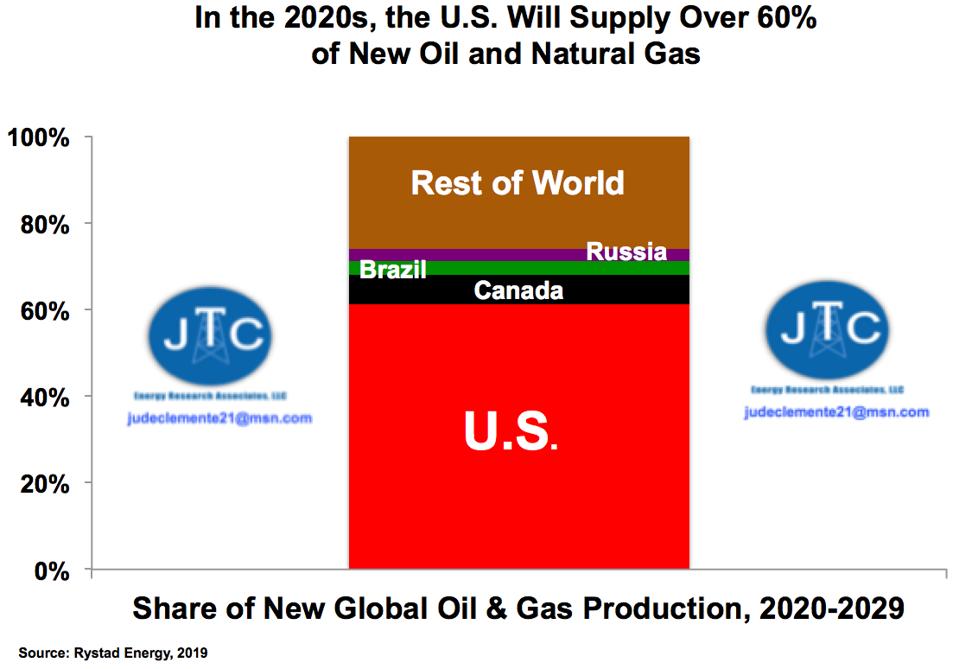
     In this article written by Jude Clemente for Forbes, I learned that our country, the United States has more than doubled the oil reserves that we have to around 65 billion barrels. On top of this, our natural gas reserves have risen to over 80% to a whopping 430 trillion cubic feet. We are now the largest producer of oil and gas, and I think that's pretty crazy. We are also expected to supply over a whole 60% of new oils and gasses to the world in the 2020's.
New oil and gas supply in the 2020sImage result for fossil fuels
     I think this shows just how much fuel we use in our everyday lives. Our use of different fuels are rising every single day, and our supply of these gasses constantly increasing shows this.

Source: https://www.forbes.com/sites/judeclemente/2019/12/08/the-us-dominates-new-oil-and-gas-production/#5fe9dccb1cce
Mayra Galvan Romero

Tuesday, February 25, 2020

Post 3 Deforestation -Emilia Schleper

 Deforestation 

Deforestation is the active permanently removing trees from the environment  to make away for something else. Forests make up more than 30% of the worlds land surfaces. They are home to over 80% of the worlds terrestrial bio diversity.  Forests provide food, medicine, jobs and fuel for over 1 billion people worldwide.
Most of today’s deforestation occurs in tropical areas. These forests are being destroyed to make way for agriculture and grazing.  Naturally occurring fires are uncommon,  but very intense and devastating to the surrounding the wildlife.  There are also human lit fires, the valuable timber is first harvested and then  any other surviving vegetation is burned away to make way for livestock and crops.  Other forests  are cleared to make way for palm oil plantations. Palm oil is a very common vegetable oil that is found in over half of all grocery store products.
 Deforestation also causes a drop in the amount of carbon dioxide absorbed by the trees.  These trees play in important role in climate change,  they are estimated to be providing  23% of  The climate mitigation needed to slow down climate change.

https://www.livescience.com/27692-deforestation.html

Natural resources skyrocket Ryan Wilburn blog 3


Global use of natural resources is skyrocketing 

Over the last 50 years, material extraction and consumption has tripled. So we are going though materials much quicker then we have before. Also since high-income countries can extract more materials, the low-income countries rarely seen any growth in material consumption, even though they have the highest need for higher material living circumstances. They are struggling to get the materials they need for their living. 


Author: Arthur Wynes


Wednesday, February 19, 2020

2nd Post Mayra Galvan Romero

     
Image result for water dams
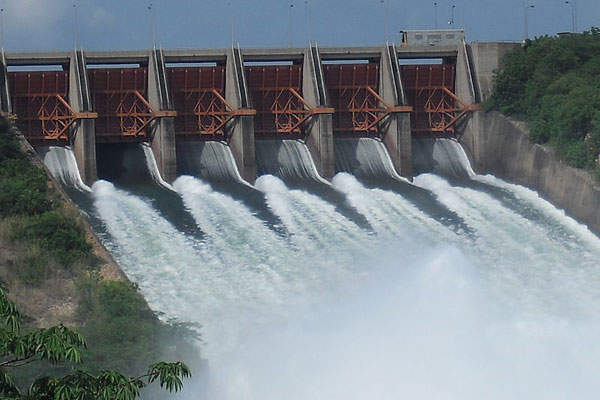
       Water dams have been a way for people to get more water for years. It is also a way for cities to generate electricity. But do dams always work? According to this article, they may be causing more harm than good. Take the city of Las Vegas as an example, where the reservoir created a 'false sense of abundance' where the amount of water available does not balance with the population that it is supposed to support. To combat this problem, different authors have recommended reducing water consumption and even the installation of water-efficient fixtures and appliances.
      Another 'fix' is to capture rainfall and use it. One of the cities that uses this method is Los Angeles. This also includes the reusing of water. This is such an important issue because water is a resource that could be put on restriction, and I don't want to imagine a world like that. 


Tuesday, February 18, 2020

Concrete Blog 2 Ryan Wilburn

Concrete: Destructive material


        Concrete is one of the most used substance used around the world just behind water. Unlike water, concrete is very dangerous to the planet and even to humans. The global building industry’s pour more then 19,000 bathtubs of concrete by the time you read this sentence. Then in a day it would be the size of China’s 3 gorges dams. Concrete is used for almost every building around the world in which the slabs protect us from the elements from outside to help keep us warm. One of the bad parts about concrete is that it loves to suck in water which is bad for places that are in a drought. It’s thirsty and is the 10th of the worlds industrial water use. In cities, concrete also adds to the heat-island effect which absorbs the warmth of the sun and it also traps the car exhausts. Last I want to talk about is that concrete destroys natural infrastructure without replacing ecological functions that we humans need such as fertilization, pollination, oxygen production and flood control. Should they find a new health substance or should they stick with concrete?


https://www.theguardian.com/cities/2019/feb/25/concrete-the-most-destructive-material-on-earth

Post 2 Plastic Oceans -Emilia Schleper

Plastic Oceans 

   Plastics are everywhere you look and everything you touch. Our oceans are full of plastic and other wastes.  The world dumps about 8 million tons of plastic into our oceans every year and it is destroying the ecosystems in which marine animals live.  Sea life often mistakes the plastic for food and consumes it but is unable to digest what they have consumed. Other animals are often found tangled in the waste unable to free themselves. This leads to millions animals deaths every year,  decreasing species abilities to survive and/or reproduce to maintain a balanced ecosystem. I’m sure we’ve all seen the photos of sea life with plastic around their necks or straws in their noses and animals that have been operated on to remove the plastic from their stomachs.  Those pictures are incredibly sad and real at the same time.  There is so much plastic in our oceans that in a few years  if we don’t do something, there will be an estimated 3 pounds of fish to every 1 pound of plastic that occupy our oceans.  Since this is a man-made problem, mankind needs to fix it.  We can all do small things that have a great impact. Instead of throwing away the plastic rings around your soda cans toss them in the recycle 3 inches to your right, and when you’re done with the soda toss those in the recycle too.  The more popular trends in reusable water bottles like Hydro flask’s and metal straws help make a difference as well.  The little things will add up, but that’s only the start, mankind needs to make a change and reduce the use of plastics and clean up the mess we’ve made.

Article: https://oceanconservancy.org/trash-free-seas/plastics-in-the-ocean/

Sunday, February 16, 2020

Post 1 Just Not Enough Fish -Emilia Schleper

Just Not Enough Fish


People all over the globe rely on fish and other sea life to add protein to their diets. This creates a high demand for fish and there are a vast number of ways for people to make money catching and selling fish. The greed of the consumers leads to greedy fishermen and salesman. The overfishing of our oceans causes environmental damage to marine ecosystems. Illegal fishing often occurs to meet this demand, these criminal nets bring in around 36.4 billion dollars every year. Overfishing can affect the size of the fish left behind, with these few remaining fish give less diversity to the ecosystem. These populations can not reproduce fast enough to support the food web and will now cause problems for other species. Fish are considered to the highest traded food products and fuels a $362 billion worldwide industry. If the overfishing continues these fish may disappear, the jobs and marine life that surround them will also disappear. The United States is the largest country importer, we import 90% of all of our country’s fish. An organization called WWF works to improve fishing  practices, management and conservation. WWF also tries to prevent criminals from stealing from illegal fisheries and close the borders of the major seafood importing countries to illegal and unsustainable harvesting practices. 


Article info: https://www.worldwildlife.org/threats/overfishing , Overfishing, Experts; Bill Fox, Michele Kuruc and Lauren Spurrier. 

Saturday, February 15, 2020

Use of Resources

     In this article written by the United Nations Environment Programme, the main topic of concern is about the rapic use of the Earth's natural resources and the damage that it causes. The first statement the article makes is about how George Monbiot, a writer for The Guardian who is also very known for his part in political activism, asked for everybody in the United Kingdom to cut the use of their cards by 90% over the following decade. This would be a huge change. The article then continues to talk about how the automobile industry alone uses a bunch of the Earth's natural resources. I was honestly shook by this, and made me view my daily life differently as our way of transportation is very important to most of us.
      The article is backed up by different studies done, as well. For example, the article states that the amount of resources we use has tripled since the 1970s. This is a 45% increase. I think that does a good job proving to the reader that we use a lot of resources now-a-days. It made me realize how many things I use throughout the day that require energy, and it's not something I think about on the regular.
     Finally, I think the article will open more people's eyes. It was also a really easy read, which honestly makes it a lot better in my eyes. It was easy to digest, and leaves a big impact on you after you finish it.

image

Source: We’re gobbling up the Earth’s resources at an unsustainable rate
Friday, February 14, 2020

Water use in USA Blog 1


           America uses roughly around 325 millions of gallons of water each day. That can fill up 1,163 Empire State buildings. 61.5% of the water is surface water, 25.5% is ground water and 13% is saline.  To start thinking about the future, We need to figure out how to tap our water resources, just not conserving but diverting each water category to the most appropriate use.

Author: Todd Reubold

Scarcity1

Michael H.

So on the subject of resources and renewable energy sources I want to talk about scarcity of resources. Scarcity has impact on all of our economic outcomes in life. For example Missouri’s largest industry is transportation equipment if there is a shortage of steel or metal resources then our state economy would plummet forcing jobs to move elsewhere. So resources need to be more wisely used. Because all economic impact on one industry affects all economic impacts on others.
https://examples.yourdictionary.com/examples-of-scarcity.html
https://www.ereferencedesk.com/resources/state-economy/missouri.html

Wednesday, February 12, 2020

Hello y’all! idk what we are doing with this, but it’s cool. This is Max

Post 5 - WIll we have enough resources? - Mayra Galvan Romero

      This article, written by Dennis Dimick for National Geographic, mainly talks about if we have enough resources for our world's pop...